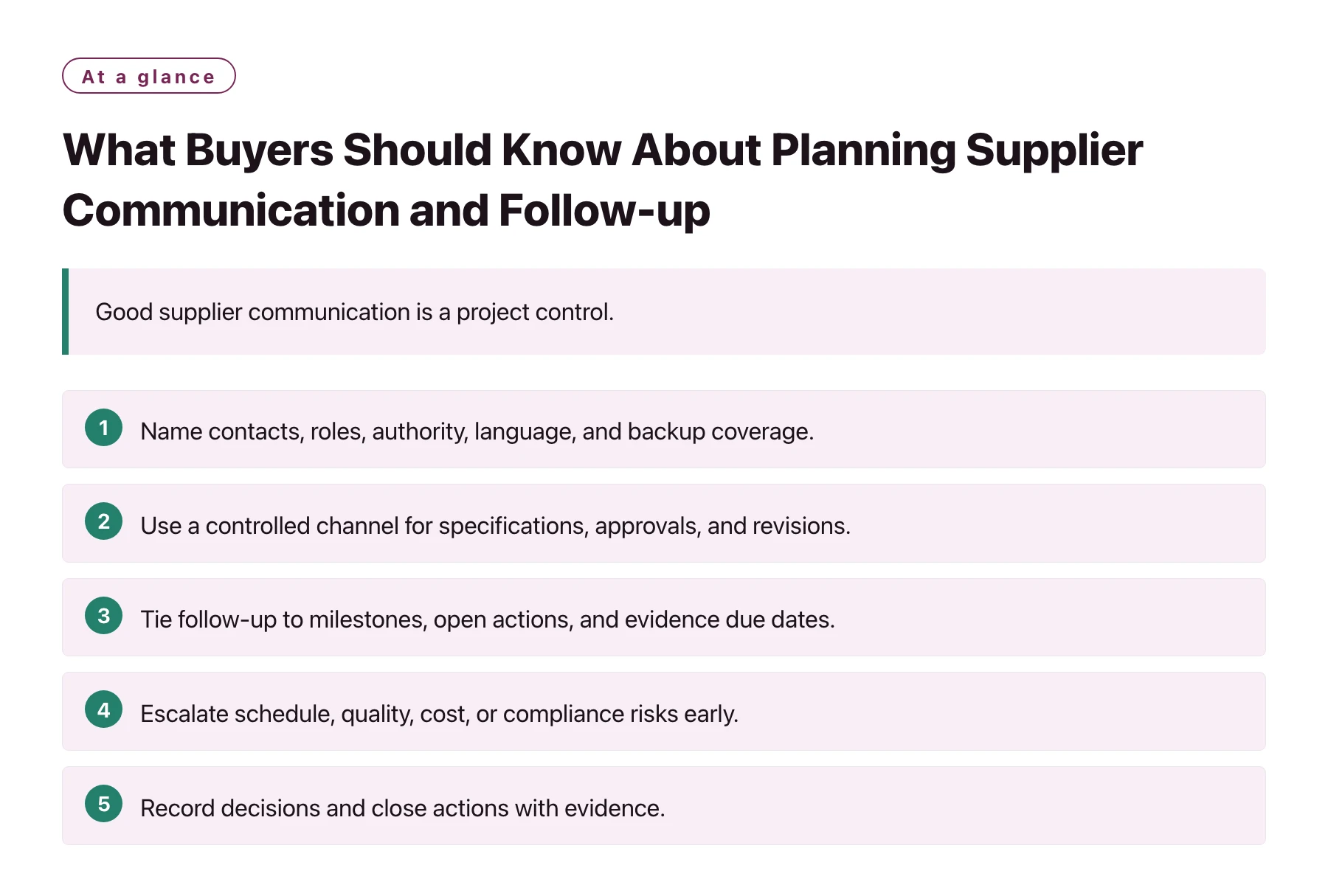
Good supplier communication is a project control. Buyers need one reliable way to share current requirements, record decisions, assign actions, and escalate risks before they disrupt production or delivery. A message thread alone is not a control system unless each issue has an owner, deadline, evidence, and documented closure.
Key takeaways
- Name contacts, roles, authority, language, and backup coverage.
- Use a controlled channel for specifications, approvals, and revisions.
- Tie follow-up to milestones, open actions, and evidence due dates.
- Escalate schedule, quality, cost, or compliance risks early.
- Record decisions and close actions with evidence.
Treat each order as a controlled release while using past performance to improve the next decision.
1. Set communication roles before asking for a quote
List buyer, supplier, factory, engineering, quality, finance, logistics, and regulatory contacts. Name who can approve specification changes, prices, samples, deviations, and shipment release. Add backup contacts for holidays and shift coverage.
Clarify whether the commercial contact can commit the factory or subcontractor. Route technical questions to the responsible specialist while keeping the project coordinator informed. A clear role map prevents conflicting instructions.
Document the normal working hours, local holidays, preferred response times, and emergency contact for shipment or safety issues. Agree how translations are checked when technical meaning matters. If several factories or buying teams are involved, identify one coordinator who can resolve conflicting instructions and keep the current status visible to all parties.
2. Choose channels by information risk
Use an agreed system for controlled drawings, specifications, quotations, reports, and approvals. Chat can be useful for quick coordination, but critical decisions should be summarized in a durable record linked to the product and order.
State file naming, version, language, date format, units, and response expectations. Restrict confidential information appropriately and identify a single current revision. Avoid sending inconsistent copies through multiple channels.
3. Turn requests into assigned actions
Every open item should state the question, required answer or evidence, owner, due date, decision needed, and impact if late. Use a shared action log for sample corrections, document gaps, pricing, tooling, packaging, and schedule risks.
Ask the supplier to confirm receipt, understanding, and target date. If a question is ambiguous, provide a concrete example or mark the item pending. Do not assume silence means approval.
4. Plan a follow-up cadence around milestones
Set check-ins for quotation, sample, order release, material readiness, first production, inspection, packing, and shipment. Increase frequency when a critical milestone approaches or a problem appears. Reduce repetitive status requests when objective evidence already answers the question.
Each update should state plan versus actual, completed evidence, next step, new risk, action owner, and expected resolution. Keep the schedule visible to both parties and revise it only through a recorded decision.
5. Keep requirement changes controlled
When a drawing, label, quantity, or delivery date changes, record what changed, who requested it, who approved it, effective order or lot, and impact on cost, testing, and schedule. Require the supplier to acknowledge the new revision before acting.
ISO 9001:2026 defines quality management system requirements; use the supplier’s system evidence to understand how documented information and communication are controlled, while agreeing project-specific channels and approvals in the order. [1]
6. Escalate risks with facts and options
Escalate a likely delay, defect trend, missing certificate, capacity issue, or unresolved technical question as soon as it threatens a milestone. State the evidence, affected units, schedule or cost impact, decision required, and feasible recovery options.
Keep escalation constructive and specific. Agree containment, owner, deadline, verification, and customer update. Avoid unsupported assurances such as “no problem” when the supplier has not checked production status or records.
7. Close meetings and actions in writing
Send brief notes with decision, open question, owner, date, and linked document. Invite corrections promptly. Store notes with the project record and revise the action log. Distinguish confirmed commitments from suggestions or estimates.
If supplier representatives change, transfer open actions and approvals formally. Ask the new contact to confirm the current specification, milestones, and unresolved risks rather than relying on an informal handover.
8. Review communication performance after delivery
Track response time for critical items, accuracy of updates, missed actions, revision errors, and how quickly issues were closed. Use the review to improve the next purchase and identify training or process needs.
Do not rank a supplier on response speed alone. Consider whether answers were complete, supported by evidence, and consistent with factory records. Keep ratings factual and linked to specific orders.
Close the review with one or two specific process changes, such as a shorter approval loop or an earlier document reminder. Assign an owner and due date to each improvement, then check whether it reduces repeated delays on the next purchase.
9. Add coordination support when complexity warrants it
Multiple products, sites, or suppliers can create different calendars and document flows. Define what support is needed—translation, meeting coordination, sample tracking, inspections, or shipment follow-up—and which decisions remain with the buyer.
Buyers working with Shanghai JS Sourcing can set a contact map and weekly action log at kickoff. Agree reporting format, confidentiality, authority, and escalation thresholds so coordination improves visibility without obscuring decision ownership.
Sources
Frequently asked questions
How often should buyers follow up with suppliers?
Set follow-up around project milestones and risk. Increase contact when evidence, production, or delivery decisions are time-critical.
Should approvals in chat count as final?
Record critical approvals in the controlled project channel with the relevant product, revision, scope, approver, and date.
What information belongs in a supplier action log?
Track issue, requested evidence or decision, owner, deadline, status, impact, and the record that proves closure.
Who should approve a supplier deviation?
A buyer-assigned technical, quality, or regulatory owner should approve within documented authority; commercial contacts should not infer that authority.