From Configurator to Delivery: Buying an EV in Australia
There is no published Australian price list for XPENG, and that is a deliberate part of the buying process rather than a gap in it. The route the manufacturer sets out is straightforward: use the online configurator to build the vehicle and get a price estimate, send that estimate to a local dealer for a formal quote, then take a test drive before you sign. Knowing what each step produces makes the whole process faster.
Key takeaways
- Start with the Build My XPENG configurator, which produces a price estimate rather than a final figure.
- A local dealer converts that estimate into a formal quote, contract or test drive.
- Warranty cover applies to vehicles imported into Australia by XPENG's Australian arm and registered in Australia.
- Scheduled maintenance is every 12 months or 20,000 km through an XPENG Authorised Dealer.
Step one: build the car and get an estimate
The configurator is where you learn the options. Build My XPENG lets you choose the model and the specification and see a price estimate for that build, which is a useful way to find out what a given configuration looks like without a salesperson in the room.
Two published choices shape the estimate early. The New G6 comes as an RWD Long Range or an AWD, and if you are shopping the larger car, the X9 is an ultra intelligent seven-seater MPV. Setting the drivetrain and seat count first avoids building a car you cannot actually buy in the specification you want.
Save the build. The estimate is meant to travel — to your inbox, to your partner, and eventually to a dealer — and rebuilding it in the showroom wastes an appointment.
Step two: take the estimate to a dealer
The dealer's job in this process is to convert an estimate into a formal quote. That is where the actual numbers for your circumstances appear, and it is also where accessories, trade-in valuations and finance discussions belong.
Ask for the quote in writing and read the specification line by line against your saved build. This is the moment to confirm the items that carry footnotes, such as power-reclining Nappa leather seats, where the published note is that availability varies by configuration.
Use the official dealer and test drive tools to arrange the visit rather than relying on a directory. The manufacturer's own Find a Dealer page lists locations, and the Test Drive page books the appointment.
The stages, and what each one gives you
| Stage | What happens there | What you leave with |
|---|---|---|
| Configurator | Choose model, drivetrain and specification | A saved build and a price estimate |
| Dealer quote | Estimate reviewed against your circumstances | A formal quote in writing |
| Test drive | Drive the route you actually use | A decision, or a different build |
| Contract | Specification, terms and cover confirmed | A committed order |
| Delivery | Registration and handover | The car plus the warranty and maintenance manual |
Step three: the test drive does the real work
A test drive is not a lap of the block. Book it for the hour you normally drive, take your own route, and include a car park, a hill and a piece of highway. Electronics you will use every day, like the Xmart OS cockpit with its OTA-upgradable interface and customisable scene modes, need a few minutes of fiddling in daylight to judge properly.
Ask about XPILOT ASSIST on the drive, because the published footnote is important: it is an assistance function, the driver must remain aware, monitor traffic and take over when needed, and it does not remove the driver's responsibility. Understanding the boundary before you own the car is better than discovering it afterwards.
Check the practical details in person too: the charge flap on the right rear quarter panel, the space where the charging cables live, and whether your own gear fits the boot.
Registration and the warranty condition
Warranty cover is described as applying to vehicles imported into Australia by XPENG's Australian arm and registered in Australia, so confirm that the car you are ordering meets both conditions. That is a short conversation at the dealership and a long one later if it is missed.
The published terms are worth knowing before delivery: whole vehicle cover of 7 years with unlimited kilometres for private use, 7 years or 160,000 km for commercial use, key parts cover of 8 years or 160,000 km, paint cover of 5 years and anti-corrosion cover of 7 years.
Keep the owner's handbook and the XPENG ANZ Warranty and Maintenance Manual for Australia together, because conditions and exclusions live in them. Support is provided directly by XPENG ANZ, and customers who bought through TrueEV are directed to XPENG ANZ support.
Worked example: planning servicing into the ownership maths
This is illustrative arithmetic drawn from one published input, the service interval of every 12 months or 20,000 km, whichever comes first. The annual distances are assumptions.
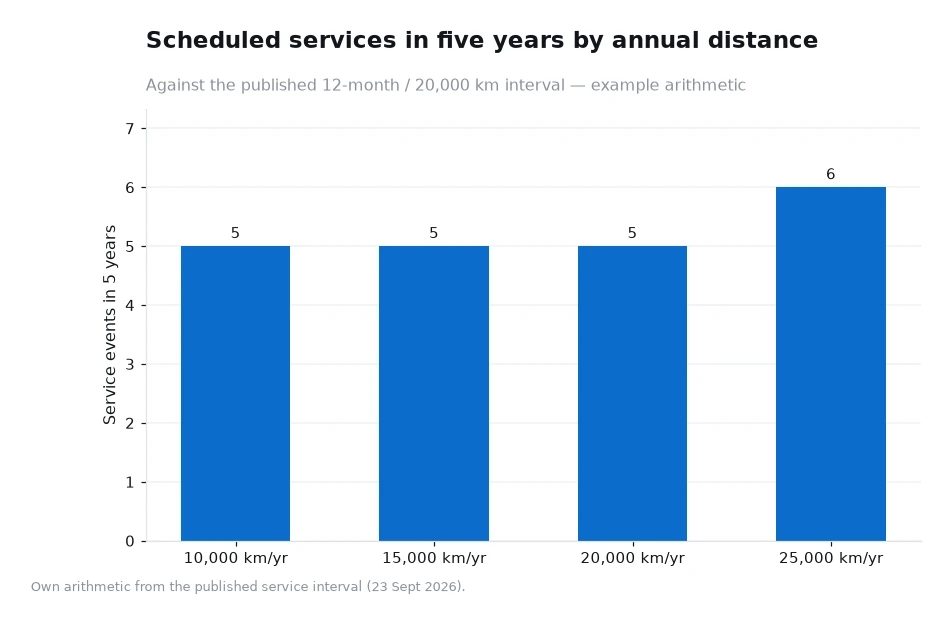
Assume you keep the car five years and cover 20,000 km a year. Then 5 x 20,000 = 100,000 km, and 100,000 divided by 20,000 = 5 services on distance, which matches the five services the calendar asks for, so five events.
At 15,000 km a year the distance figure is 5 x 15,000 = 75,000 km, and 75,000 divided by 20,000 = 3.75, so distance alone would ask for three, but the calendar asks for five and the calendar wins, so five events. At 25,000 km a year, 5 x 25,000 = 125,000 km and 125,000 divided by 20,000 = 6.25, so six events, with the sixth inside the fifth year.
One more check is worth doing at the same time. At 20,000 km a year, eight years is 8 x 20,000 = 160,000 km, which is exactly the published key parts limit, so at that annual distance the warranty and the odometer run out together. No service pricing is published for Australia, so ask your dealer for a written quote against the schedule you expect to follow.
Frequently asked questions
Can I get a final price before visiting a dealer?
The Australian site does not publish prices. The stated path is to build the vehicle in the online configurator to get a price estimate, then send it to a local dealer for a formal quote, a contract or a test drive, and the quote is where your actual figure is confirmed.
What has to be true for the warranty to apply?
Published cover applies to vehicles imported into Australia by XPENG's Australian arm and registered in Australia, with scheduled maintenance every 12 months or 20,000 km recommended through an XPENG Authorised Dealer. Conditions and exclusions are set out in the XPENG ANZ Warranty and Maintenance Manual for Australia.
After delivery: the Owner's App and remote diagnostics
Set up the XPENG Owner's App in the first week. It handles scheduling for maintenance and services, and it is the simplest way to keep a record that later supports a warranty conversation. Remote diagnostics is listed as standard equipment and can sometimes resolve an issue without a workshop visit at all.
Then set your home charging routine. The published home features include plug and charge, anti-theft locking, multi-account sharing and a charging schedule, and the car is compatible with most Type 2 AC and CCS2 DC chargers.
Read the published detail for the mid size electric suv range before you build your own, and download the app from the official app download page so you are working from the manufacturer's copy rather than an old one.
The buying path, warranty terms and service interval described here come from the manufacturer's Australian site at xpeng.com/au, read on 23 Sept 2026, with conditions and exclusions in the XPENG ANZ Warranty and Maintenance Manual for Australia. The annual distances used in the example are the author's own assumptions. [1]