From $0.77 to $839.92: Reading a Crystal Price Ladder
The Genshin Impact ladder on KeyGold starts at 60 Genesis Crystals for $0.77 and ends at $839.92 for a ten-pack of the 6480+1600 listing. Read as a single column it looks like a simple rise; read per crystal, it is a curve with a flat middle and a surprise at the top.
Key takeaways
- The bottom rung is 60 Genesis Crystals at $0.77 against a $0.99 list price.
- The 6480+1600 listing is $74.99, and the ten-pack of it is $839.92 against $999.90 at list.
- Genesis Crystals convert to Primogems one for one, and a Wish costs 160 Primogems.
- Prices are shown in USD; a bank may add its own conversion fee on a non-dollar card.
How the ladder is built
Each rung is a pack size plus a price, and most of the middle rungs are written as a base plus a bonus, such as 980+110 or 3280+600. The bonus is part of the pack, so the totals are 1090 and 3880 crystals respectively. The two ends are different in character: the 60-crystal listing exists to top up a balance that is slightly short, while the 6480+1600 family is aimed at a player who wants a large block at once.
The bottom half of the ladder behaves as you would expect. As the pack grows, the price per crystal falls, because the discount published for Genshin Impact — 28% on the store's home page — applies to a bigger base. That is the ordinary shape of a bulk-buy shelf, and it holds from the 60-crystal rung up to the 6480+1600 listing.
KeyGold sells these packs as a third-party service, and the route is a login top-up: the account is a HoYoverse Account, the store signs in with the details you supply, buys the pack in the game's own shop and then signs out and clears the login history on its side. Nothing about the pack contents changes, and the pages state that in-game bonuses are applied the same as a self-purchase.
The full published ladder, divided out
The table takes five rungs and adds a column the page does not print: the price of a single crystal at each listing. The first three columns are published; the last is my division.
| Pack | Price (US$) | List price (US$) | Crystals | Price per crystal (US$) |
|---|---|---|---|---|
| 60 | 0.77 | 0.99 | 60 | 0.012833 |
| 980+110 | 10.83 | 14.99 | 1090 | 0.009936 |
| 3280+600 | 36.12 | 49.99 | 3880 | 0.009309 |
| 6480+1600 | 74.99 | 99.99 | 8080 | 0.009281 |
| 6480+1600 ×10 | 839.92 | 999.90 | 80800 | 0.010395 |
The last row is the surprise. At the published figures, the ten-pack costs $0.010395 per crystal while a single 6480+1600 listing costs $0.009281 — the multi-pack works out more expensive per crystal than buying the single listing, even though its absolute cash difference from list is far larger. The same pattern appears one rung down: the ×3 listing is $244.97 against $299.97 at list, which is $81.66 per pack against $74.99 for the single listing. Anyone who assumes "bigger is always better per unit" will be wrong on this particular ladder, and only the division reveals it.
Worked example: the cheap rung against the efficient rung
Comparing the two extremes makes the curve obvious. These are my own calculations on the published prices, and I am treating bonus crystals as part of the pack, which is how the listing presents them.
Step 1 — the smallest rung. 60 crystals for $0.77: 0.77 ÷ 60 = $0.012833 per crystal.
Step 2 — the middle of the ladder. 980+110 = 1090 crystals for $10.83: 10.83 ÷ 1090 = $0.009936 per crystal.
Step 3 — the difference. 0.012833 − 0.009936 = $0.002897 per crystal, or 0.002897 ÷ 0.012833 = 22.6% lower. So the middle rung is about a fifth cheaper per crystal than the smallest one, and much closer to it in cash than the largest rung.
Step 4 — the top of the ladder. The ×10 listing at $839.92 for 80,800 crystals: 839.92 ÷ 80800 = $0.010395 per crystal, which is 0.010395 − 0.009281 = $0.001114 more expensive per crystal than the single 6480+1600 pack.
Step 5 — turning it into Wishes. Because crystals convert to Primogems one for one and a Wish costs 160 Primogems, the middle rung covers 1090 ÷ 160 = 6.8, so 6 Wishes with 130 Primogems left over. At $10.83 that is $1.805 per Wish under the assumption that every crystal in the pack is spent on pulls.
The same ladder, drawn as bar pairs
Reading a ladder from a picture is easier once the division has been done by hand. The chart below returns to the Genshin Impact page and draws three tiers as pairs of bars — 60 crystals at $0.77 beside $0.99, 980+110 at $10.83 beside $14.99, and 6480+1600 at $74.99 beside $99.99 — so the two published figures for a rung sit next to each other rather than in separate columns of a table.
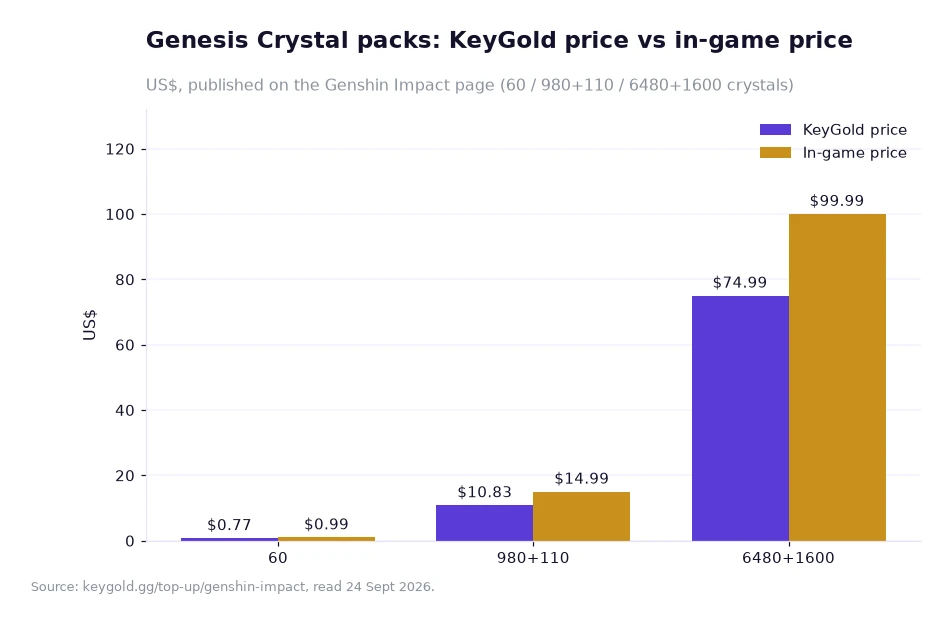
The contrast with the table above is the point. On the chart the bars simply grow, and a reader going by height alone would take the top rung for the best buy; the divisions say otherwise for the multi-pack rows, which is why the two views belong side by side. Read one rung at a time, and remember that the in-game figure drawn beside each bar is a reference rather than the sum you pay. The game list shows which other titles the store carries, if you want to compare ladders directly.
What the order needs, and how fast it lands
For Genshin Impact the published delivery window is 5–30 minutes, around the clock, with longer queues in the first hours of a new banner. The form asks for the HoYoverse Account email and password plus the server your character plays on, from America, Europe, Asia or TW-HK-MO, and only one active session per account is allowed, so stay out of the game while the order runs. After delivery the published advice is to change the password and keep two-step verification reachable.
Support is a live chat with a real person 24/7, order status sits in the Order Record at any time, and the site publishes a Full Refund Guarantee: if an order is not delivered or cannot be used, you receive a full refund. A first order can use the published new-user coupon — 15%, one coupon, no threshold, valid 30 days. The page that carries the whole ladder, price and list price side by side, is the one that answers a search for cheap genshin top up, and the help center explains the form field by field.
Frequently asked questions
Is the most expensive listing the best value per crystal?
Not at the published figures: the 6480+1600 ×10 listing at $839.92 works out to $0.010395 per crystal, while the single 6480+1600 listing at $74.99 works out to $0.009281.
How much does a Wish cost after the pack is divided out?
Under the published rates, where one Genesis Crystal becomes one Primogem and a Wish costs 160 Primogems, the 980+110 listing covers 6 Wishes at about $1.805 each.
Reading any ladder in three steps
Total the crystals including the bonus, divide the price by that total, then compare the result across two or three rungs rather than the whole shelf. That routine catches the multi-pack anomaly described above and prevents a purchase made on the strength of a big cash difference alone. Keep the conversion facts in mind while you do it: one crystal becomes one Primogem, and a Wish costs 160, so any per-crystal figure can be multiplied by 160 to give a price per Wish. When two rungs come out close, choose the smaller one — the delivery window and the process are the same, and less sits on a single order.
There is one more habit worth building while the ladder is open in front of you. Write down the crystal total and the price for the two rungs you are considering, then repeat the division after any promotion you see advertised, because a shelf rate can change and a remembered figure can go stale. The published list price beside each listing is your fixed reference; the store price is the one that moves. If a promotion makes the larger rung finally beat the smaller one per crystal, that is the moment to reconsider your usual choice — and if it does not, the arithmetic has saved you a purchase you did not need. Two minutes with a calculator replaces guesswork, and the numbers are all printed on the same page.
Pack sizes, prices, list prices, delivery windows, coupon terms and refund wording come from KeyGold's own pages, read 24 Sept 2026; the price-per-crystal and price-per-Wish figures are my own division on those published numbers.[1]